
Looking over Viridian materials for that retrospective, one paragraph from the Viridian Principles jumped out at me as particularly sharp:
“Nature” is over. There’s not a liter of seawater anywhere without its share of PCB and DDT, and an altered climate will reshuffle the ecological deck for every creature that breathes. A 21st century avant-garde must deal with those consequences and thrive in that world. We have already painted flowers. We want to know what a flower means when a flower has onboard processing, amped- up genetics, and its own agenda. Thus a central Viridian aesthetic dictum: “A Rose is No Longer a Rose.”
My contribution to the retrospective is now online: A Rose is No Longer a Rose, on why we bother ‘restoring’ habitat when Sterling is right to say that we can never have back what used to be.
2017 update: now that a few years have passed, I want to archive the text of the Medium post here, so I’m not dependent on a third-party host to keep this online (it’ll still look better on Medium, this is purely a backup):
A Rose is No Longer a Rose
What does habitat restoration mean in a heavily engineered biosphere?
I volunteer at habitat restoration sites in Seattle, a city that worships the idea of Nature while drunkenly bulldozing the reality. Each site is part of a broader effort to clean up after ourselves, in the hope that this will bring back the totemic salmon. These magnificent, delicious fish have been a keystone of Northwest Native and settler culture alike, and old stories describe them as so abundant that “you could walk across the rivers on their backs.” Having driven them halfway to extinction by overfishing and habitat removal, the region is now doing what it can to repair the damage.
We’ve had some successes, but only rather modest ones: a few salmon are back in creeks that had lost them, and some existing runs are growing. Getting immersed in habitat restoration serves as a constant reminder that:
“Nature” is over. There’s not a liter of seawater anywhere without its share of PCB and DDT, and an altered climate will reshuffle the ecological deck for every creature that breathes. —Bruce Sterling, Viridian Principles
For a couple of years, I adopted a site on the Duwamish Waterway, coming back regularly to monitor and work on that one place. Through this time a small group of volunteers cleared trash, pulled out invasive plants and planted native species. That it’s called “Waterway” rather than simply “River” is a hint about how engineered the setting is. This was where we maintained a little tidal marsh in a cove that almost looked plausibly natural.
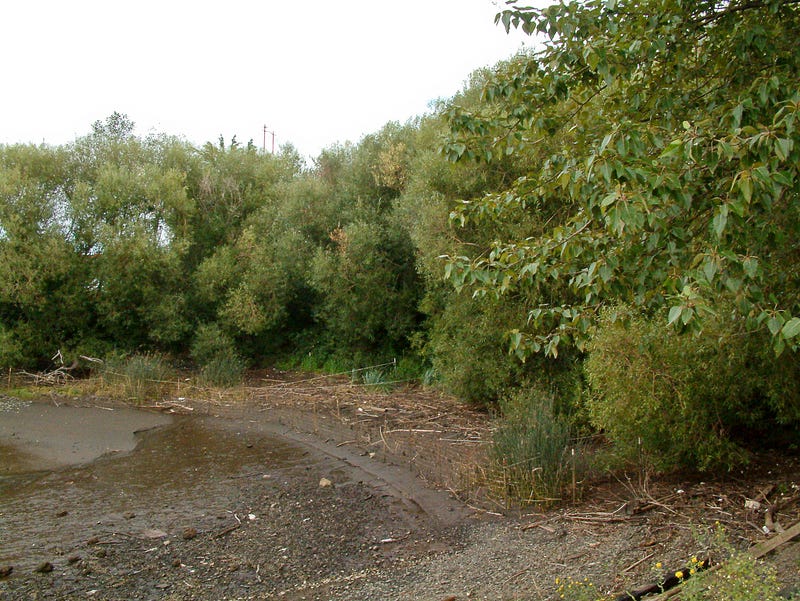
The fencing is to keep geese out so they don’t overgraze the plants we’re trying to get established so that next year’s geese can graze on them.
In theory, we gave salmon a set of things they needed. For the adults: a calm backwater to rest on their way upstream. For the young: some places to hide from predators on their way to sea, and native plants that draw insects for them to eat. We haven’t seen salmon breed on this river yet. At times the whole exercise feels like the proverbial cargo cult, building a simulacrum of habitat in the hope that one day the salmon will return. No matter what we do here it will still be a tiny refuge among the acres of concrete, the miles of straight lines and the thousands of cars.
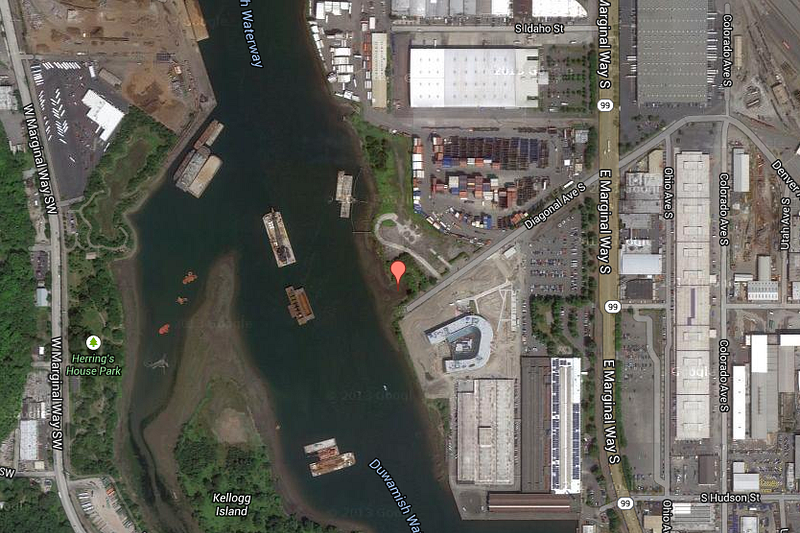
(source: Google Maps)
Even if we had all the volunteers needed to restore the whole length of riverbank, the sediment would still be loaded with chemicals toxic to fish and humans. If the Superfund cleanup is ever completed, the surrounding industry and roads would continue to seep more pollutants with every rain storm; a continuous slow-motion oil spill. If we solved that, the river would still be too warm and oxygen deficient, because two thirds of the water that used to flow into this channel has been diverted. If all of that were undone, uprooting all the people who now live in the historic channels, lakes and wetlands, only a fraction of the original salmon population could return, because the overfished ocean simply can’t support as many as it used to. And if some magic brought all those fish back they would still be in danger. The climate change locked in by greenhouse gases already emitted will wreak havoc with the whole system all over again.
So why do we bother?
There’s a vast spectrum between concrete hell-hole and pristine idyll, so falling short of perfection is no reason to give up. Complete success is not even a desirable state, given that we’d have to erase ourselves to achieve it. As Sterling put it: “There’s no one so green as the dead”. But to defend our intervention as even a partial success, we have to understand why inaction would be a mistake. The Viridian Principles start with a useful reminder:
It’s perfectly acceptable to supersede some time-honored tool or practice. However, you should take pains to fully comprehend the thing you have rendered obsolescent.
Our ancestors didn’t fully comprehend what they were throwing away when they cut down the trees, paved the land and changed the course of rivers. They had a vision of what they wanted to make, but they either ignored or didn’t understand the cost, and we are left with fewer fish and more floods. There’s no point in being angry with long-dead humans for their lack of foresight, but there’s plenty we can do to improve our situation. Back to the Viridian Principles:
A 21st century avant-garde must deal with those consequences and thrive in that world. We have already painted flowers. We want to know what a flower means when a flower has onboard processing, amped- up genetics, and its own agenda. Thus a central Viridian aesthetic dictum: “A Rose is No Longer a Rose.”
The flower will have to speak for itself, but we humans have our own agenda. Many of us do habitat restoration to improve our own living conditions and those of other people around us. Sometimes we even succeed. Here are some questions to clarify when a restoration project was worth the time and effort:
Does it create or enhance a place of refuge? You don’t have to dislike the city to appreciate its quiet, green spaces — just look at the popularity of Central Park with proud New Yorkers. Urban habitat restoration is much harder work than locking up remote reserves and keeping people out, but it’s worthwhile precisely because it makes better spaces that people can use.
Does it give humans a more hospitable habitat? The benefits of restoring a site often extend far beyond that site itself. Tear up some concrete to expose old soil and the people living downstream of you get less flooding and cleaner water. Plant a barren strip of ground and the people downhill are less likely to suffer landslides. Bring back native pollinators and your neighbours’ gardens will also thrive.
Will it leave us with more resources? In between Edenic idylls and dark satanic mills lies a range of futures. We restore what we can because each step leaves us with some more fish to eat, not because we expect to get all of them back.
Is it resilient? Often the work of habitat restoration is to take a monoculture—whether a field or a neglected corner overrun with blackberries—and replace it with a diverse mixture of plants. This doesn’t have to be driven by a blind faith in the “natural”. Experience has shown that these mixtures do better in the face of predators, disease and environmental disturbance. Climate change, which promises some degree of disturbance to every place on Earth, makes this more important.
Simplest of all: is it beautiful? Big engineering projects can be quite beautifuland natural systems thoroughly ugly, but our civilisation is full of ugly, neglected fringes of industrial sites. Making ugly sites beautiful has a value in itself.
If we understand habitat restoration as an effort to undo history, it is always doomed to fail because humans have changed our world so dramatically. If we view restoration as an effort to make the world better for ourselves in particular, well-understood ways, then much has been achieved, and there’s plenty to keep working for.
Thanks, I enjoyed the post. I’ve done habitat restoration work in San Francisco and it does seem like “what’s the point?” comes up a lot. As you say, people seem to get wrapped up in the idea that we have to eradicate invasive species and make things back the way they were. I try to keep a different perspective: nature is resilient and adaptable, but can be pushed so far out of balance that it degenerates into monoculture. A reasonable goal is to try to help hold off the invasive monocultures long enough for the ecosystem to find a new balance. Unfortunately this is more of an article of faith for me than a scientifically researched position; would love to be more informed as to how this all really works in practice.
Thanks for commenting! It’s a funny business, writing, because people normally only comment to disagree. Silence could mean everyone thinks what I wrote was reasonable, or they just don’t care – it’s nice to get some disambiguation….
I think your perspective makes sense, though I don’t have any research to back it up either. My general understanding is that the damage humans do is more to do with the speed of the changes we cause than exactly what they are, so any slowing down gives the ecosystem a better chance of accommodating the change instead of collapsing.
Just anecdotal, but I saw a talk about native butterfly species in SF and what really struck me was how many of the species have successfully migrated to invasive host plants. I usually think of host plant choices as hard to change, but it seems with enough transition time this is manageable.
I guess to some extent my comment gets to the (I think useful) dichotomy between engineering solutions and management solutions. We’re tempted to take an engineering perspective and try to “solve” (i.e. eradicate) invasives. But it’s really more of a management issue.
Engineering vs. management credit here: http://www.fourmilab.ch/hackdiet/www/subsubsection1_2_1_0_4_2.html
Oh, thank you for this! I think that dichotomy is useful in general and relevant here, but what I really appreciate is that the thing you just linked to is the best explanation of why one of the tribes I associate with complains so much about the other’s “solutionism”, and what they mean by that.